Record gold prices shift the focus to recovery



For more than a decade, the argument for investing in better agitation in gold processing was a defensive one: spend now to protect your margins while the gold price keeps falling. That argument no longer holds. Gold climbed to record highs near $5 600/oz in early 2026 and has stayed well above $4 000/oz, more than three times its 2013 level. The priority has shifted with the price. The question is no longer only how to lower the cost per ounce. It is how to recover every ounce held in ore that is steadily becoming harder and leaner to treat. At these prices, recovery is where the value lies, and the agitator is one of the most underrated tools an operator has to capture it.
What happens inside the leach tank decides how much gold you recover, whether the process route is carbon-in-leach, carbon-in-pulp with or without pressure oxidation (POX), bio-oxidation or atmospheric oxidative leaching. The agitator sets the conditions: how well solids stay suspended, how finely gas is dispersed, and how uniform the reaction environment is across the vessel. When mixing falls short, the symptoms are familiar. Dead zones form, oxygen reaches some regions and not others, reagent is wasted, acid concentrates into hot spots that attack the equipment, and part of the gold simply leaves with the tailings.
The economics at today’s prices are hard to ignore. Take a mine producing 100 000 oz/y. Lifting recovery by a single percentage point puts roughly 1 000 more ounces into production, worth about $4-million a year when gold sells at $4 000/oz. Against that, the cost of a better-designed agitator or a focused retrofit barely registers. The same one-point gain was worth a fraction as much when gold traded near $1 200. Today it can reshape the economics of an operation.
The Efficiency Dividend
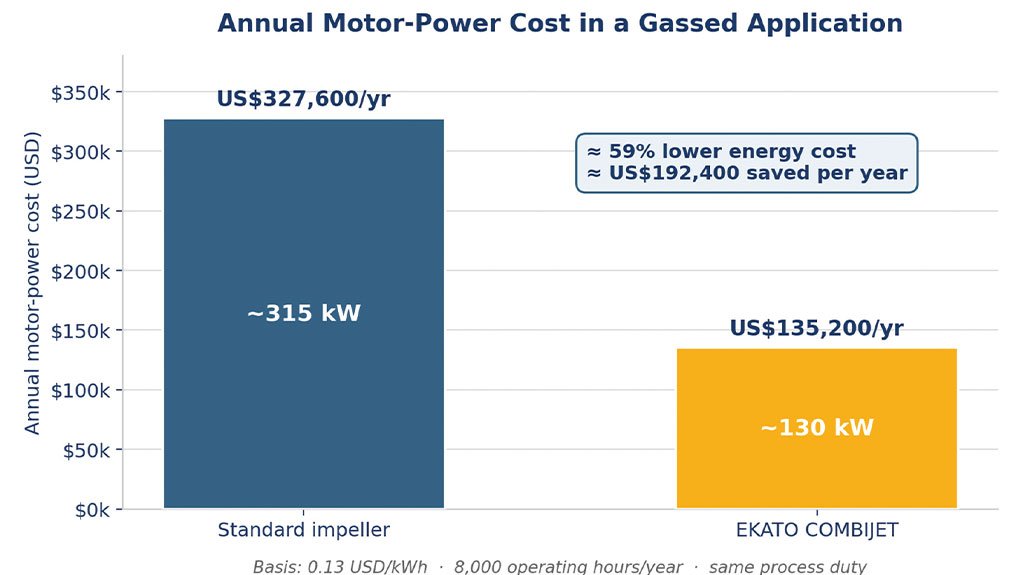
Recovery is the first prize, but efficiency is close behind, and the case for it has grown stronger rather than weaker. In one representative gassed application, swapping a standard impeller for an EKATO COMBIJET brought the installed motor power down from about 315 kW to about 130 kW at the same process duty, a cut of almost 60% (Figure 1). Industrial power costs more than it did ten years ago, and in many operations a stable supply cannot be taken for granted, so a saving of this size goes straight to the operating line. It also opens savings further down the train: smaller compressors and blowers, less oxygen consumed, and shorter batch cycles that give back plant capacity.
Thanks to the excellent dispersion and suspension performance of the EKATO COMBIJET, similar optimisations can also be realised in gold recovery processes. Recoveries of up to 101% (relative benchmark performance) can be achieved, while still operating at significantly lower power input compared with conventional systems designed for a 100% baseline case.
There is a third benefit that hardly featured in these conversations a decade ago. Every kilowatt-hour saved takes a bite out of Scope 2 emissions, and with them the carbon carried by each ounce produced. Decarbonisation has moved from the sustainability report into real commercial territory, shaping financing terms, permits and offtake talks. That puts energy-efficient agitation in a useful position: it lowers cost and carbon at the same time, with no trade-off between the two.
The wider trend only sharpens the point. Average head grades keep falling across the gold sector, which means more ore has to move through the plant to yield the same ounce. Inefficiencies that were easy to live with when grades were rich now bite across far greater tonnage. The leaner the ore, the more every point of recovery, and every avoided loss, is worth.
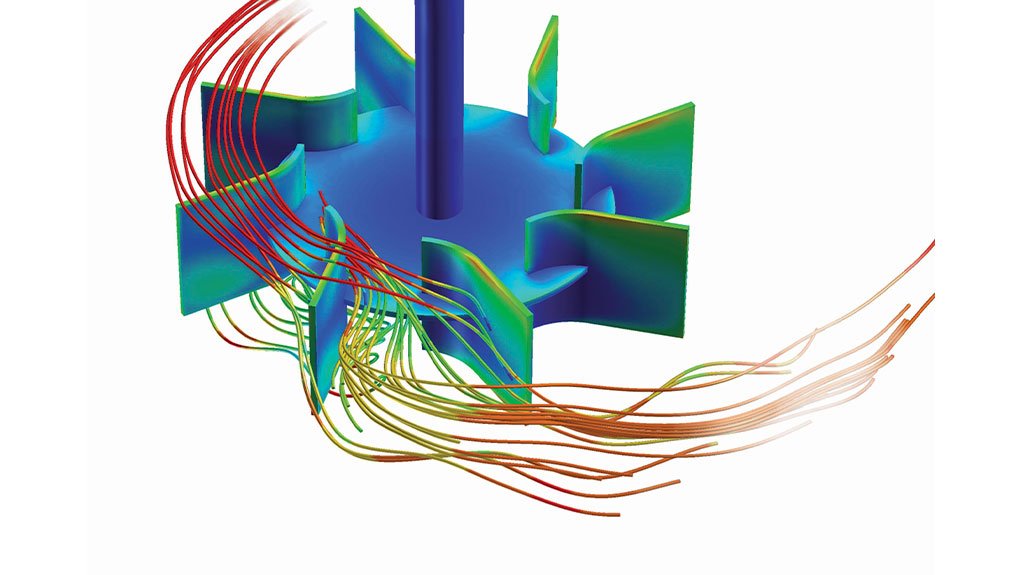
None of this counts for much if the machine will not run. An agitator must cope with normal duty and with the awkward moments too: a restart into a settled bed after a power trip, or running through filling and emptying. Designing for those cases means the mechanical and process sides must work as one. The right materials, good coatings and computational fluid dynamics- (CFD-) optimised blade shapes hold back abrasion and erosion, which are usually what drive unplanned stoppages and spare-parts spend (Figure 2). Quick, even mixing also keeps acid from building into the hot spots that eat away at impellers and tank internals.
De-risking Through Engineering
Capital is scrutinized closely these days, and a good equipment partner gives you the basis to make the call with confidence. Deep process know-how, well-equipped laboratories and pilot rigs, and simulation tools such as CFD and finite element analysis make it possible to predict the real process result early, before the money is committed. Scale-up experience earns its keep on expansions, where it avoids the blunt approach of simply “numbering up” and can trim the count of agitators, vessels and the pumps and compressors around them. A feasibility study is still the surest way to put numbers on the opportunity and keep the schedule intact.
On a total cost of ownership basis, these investments often pay for themselves within months, and at today’s prices the payback comes round faster still. The best outcomes tend to come from operator and technology partners working closely together, where shared engineering and clear process guarantees turn an ordinary tank into a measurable source of recovered metal.
With gold at levels few expected to see, the operators who come out ahead will be the ones who stop treating the agitator as just another piece of equipment and start treating it as a tool to improve gold recovery, energy consumption, and plant reliability. Backed by solid engineering, advanced mixing technology is one of the shortest routes to making the most of today’s gold price.
Article Enquiry
Email Article
Save Article
Feedback
To advertise email advertising@creamermedia.co.za or click here
Research Reports

Projects

Latest Multimedia



Showroom
Design, Construction and Maintenance of Site Erected, Welded Bulk Storage Tanks for the Petrochemical, LNG, Ammonia and Sustainable fuel Sectors.
VISIT SHOWROOM


Press Office
Announcements
What's On
Subscribe to improve your user experience...
Option 1 (equivalent of R125 a month):
Receive a weekly copy of Creamer Media's Engineering News & Mining Weekly magazine
(print copy for those in South Africa and e-magazine for those outside of South Africa)
Receive daily email newsletters
Access to full search results
Access archive of magazine back copies
Access to Projects in Progress
Access to ONE Research Report of your choice in PDF format
Option 2 (equivalent of R375 a month):
All benefits from Option 1
PLUS
Access to Creamer Media's Research Channel Africa for ALL Research Reports, in PDF format, on various industrial and mining sectors
including Electricity; Water; Energy Transition; Hydrogen; Roads, Rail and Ports; Coal; Gold; Platinum; Battery Metals; etc.
Already a subscriber?
Forgotten your password?
Receive weekly copy of Creamer Media's Engineering News & Mining Weekly magazine (print copy for those in South Africa and e-magazine for those outside of South Africa)
➕
Recieve daily email newsletters
➕
Access to full search results
➕
Access archive of magazine back copies
➕
Access to Projects in Progress
➕
Access to ONE Research Report of your choice in PDF format
RESEARCH CHANNEL AFRICA
R4500 (equivalent of R375 a month)
SUBSCRIBEAll benefits from Option 1
➕
Access to Creamer Media's Research Channel Africa for ALL Research Reports on various industrial and mining sectors, in PDF format, including on:
Electricity
➕
Water
➕
Energy Transition
➕
Hydrogen
➕
Roads, Rail and Ports
➕
Coal
➕
Gold
➕
Platinum
➕
Battery Metals
➕
etc.
Receive all benefits from Option 1 or Option 2 delivered to numerous people at your company
➕
Multiple User names and Passwords for simultaneous log-ins
➕
Intranet integration access to all in your organisation